artistic approach:
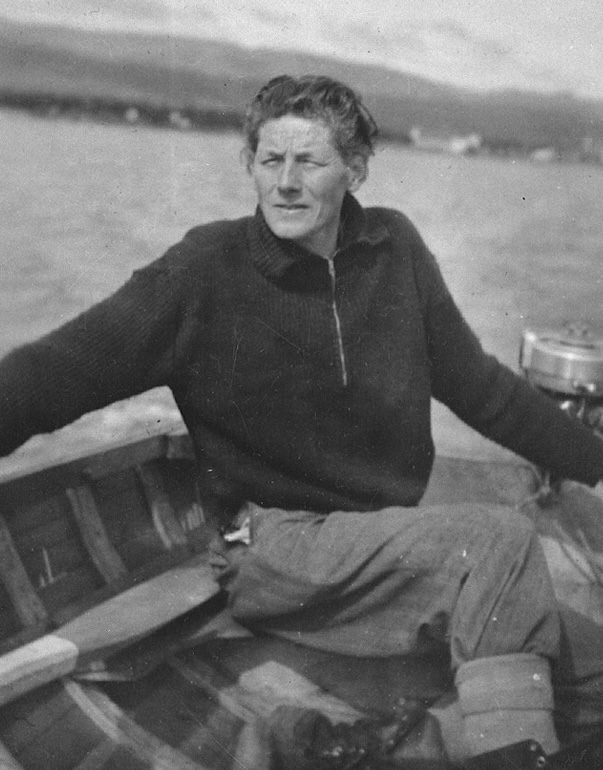
Painter René Richard was born on December 1, 1895, in La Chaux-de-Fonds (Switzerland) and died in Baie-Saint-Paul (Quebec) on March 31, 1982. The son of an immigrant who settled with his entire family in Cold Lake (Alberta), he was drawn very early to wide open spaces and the sense of freedom they provide. Thus, at the age of 18, he became a coureur des bois, learning the hard way the trade of trapper, which he practiced for several years. Throughout this period, he made hundreds of pencil drawings, which testify to his passion for the northern wilderness and the daily life of the Indigenous peoples he regularly encountered. In 1926, he took his first drawing lessons in Edmonton (Alberta) and the following year went to Paris to further his training at the Académie de la Grande Chaumière. In the French capital, he met the Montreal painter Clarence Gagnon, who became his mentor and friend. Upon his return to the country in 1930, René Richard returned to the life of a coureur des bois, this time carrying tubes of paint, pencils, and wrapping paper to use as canvases. It was during this period that he found his true style, freeing himself from the classicism that had marked his earlier works. “Quickly drawn on paper, the line runs, sometimes light, sometimes firm, outlining the trunk of a tree, lightening the curve of a cheek before resuming its course and sliding like a skater performing an extravagant ballet. The artist gives free rein to his fantasy and imagination, and in doing so, while drawing inspiration from the subject, he goes beyond it and magnifies it.” (Hughes de Jouvancourt). Then, in 1938, Clarence Gagnon took his friend to Baie-Saint-Paul (Charlevoix), a village he particularly loved. Struck by the beauty of the place, René Richard returned a few months later to settle there permanently and devote himself to his art. In 1942, he married Blanche Cimon, the daughter of the people who had hosted him since his first visit. The following year, he held his first exhibition at L’Art français. It was a great success, selling all his paintings in less than two days. This was followed by exhibitions in three renowned galleries: the Klinkhoff Gallery in Montreal, the Zanettin Gallery in Quebec City, and René Bergeron’s gallery in Chicoutimi. Later, having become friends with Gabrielle Roy and Bishop Félix-Antoine Savard, he illustrated their respective works, namely “La montagne secrète” (1975) and a new edition of “Menaud, maître-draveur” (1979).
In 1973, René Richard was awarded the Order of Canada, and in 1980 he became a member of the Royal Canadian Academy of Arts. That same year, he donated a large collection of paintings and sketches to Laval University, as well as a dozen drawings used to illustrate “Menaud, maître-draveur.” Upon his death, his legacy was enriched by 131 paintings and drawings. Among the many exhibitions dedicated to him, both during his lifetime and afterward, are those of the Musée du Québec (now the Musée national des beaux-arts du Québec) in 1967 and 1978, the City of Montreal (1986), the Villa Bagatelle in Quebec City (1990), La Chaux-de-Fonds (Switzerland) (1992–1993), the Baie-Saint-Paul Art Centre (now the Contemporary Art Museum of Baie-Saint-Paul) (1993), and the Domaine Cataraqui in Quebec City (1996).
“Prolific, René Richard is undoubtedly one of the Canadian painters who best expressed nordicity, solitude, and the primitive life of vast territorial spaces marked by the seasons. His contribution to pictorial art is impressive: hundreds of works, mainly studies, drawings (sketches, drafts, sanguine and charcoal studies, oil sketches, colored pencil drawings, and felt-tip pen drawings) and small and large format oils… Richard’s art, very personal and marked by a certain expressionism, also expresses survival in extreme conditions, confronted with natural elements such as rivers, polar deserts, and forests.” (Esther Pelletier, full professor, Laval University).